Best Books on COVID-19 Origins
COVID-19 origins get argued in two registers: evidence on Wuhan and the lab-leak debate, plus the zoonotic “jump to humans” pathway. These books sharpen both lenses, from Viral by Alina Chan and Matt Ridley to Spillover by David Quammen.
Viral
Alina Chan, Matt Ridley
After Viral, the origin debate feels less like a slogan and more like a chain of testable claims you can weigh.
Evidence should predict what you would see next.
It walks through what origin evidence actually shows, then sets lab-leak possibilities against zoonotic alternatives in a way that stays grounded in what evidence can support. That matters for COVID-19 origins because it trains your skepticism on mechanisms, not talking points.
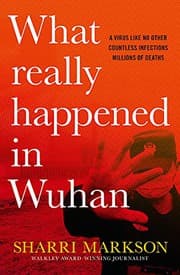
What Really Happened In Wuhan
Sharri Markson
What Really Happened In Wuhan turns “origins” into a timeline problem: who knew what, when, and why details keep shifting.
Timelines win or lose credibility.
This journalistic reconstruction treats the early record as contested and documents competing claims about timelines and actors. For COVID-19 origins, it helps you separate chronology and attribution from the heat of the lab-leak debate.
The Truth about Wuhan
Andrew G. Huff
The Truth about Wuhan reframes origins as a question of institutional knowledge: lab safety, research networks, and what was observable early on.
Lab safety failures change what “possible” means.
Huff builds an insider-framed case around lab-leak concerns and the surrounding scientific ecosystem. For your topic, it foregrounds how origin investigations can hinge on process and transparency, not just biology.
The Wuhan Cover-Up
Robert F. Kennedy Jr.
The Wuhan Cover-Up is written like a prosecution file, arguing that suppression and obstruction shaped what the public learned about origins.
Public narrative can diverge from early facts.
It leans into suppression claims and the political fight around origin narratives. For COVID-19 origins, it can be useful as a high-volume expression of the lab-leak side, with the trade-off that you will want to cross-check its assertions against other evidence-based accounts.
American Contagions
John Fabian Witt
American Contagions changes how you think about “origins” by treating pandemics as policy, preparedness, and institutional response under stress.
Politics and preparedness shape what evidence gets used.
Instead of focusing only on Wuhan details, it gives the background that shaped U.S. understanding and reaction as early origin debates surfaced. That matters because origin narratives do not develop in a vacuum: they travel through organizations, funding, and risk management.
Spike
Jeremy Farrar, Anjana Ahuja
Spike captures the early emotional whiplash of uncertainty, then shows how origin questions get asked while scientists are still learning basics.
Uncertainty does not mean ignorance.
As an insider account, it focuses on the early outbreak period when uncertainty was real and the origin discussion was evolving. For COVID-19 origins, it helps you understand why different hypotheses gained traction at different times.
Timelines win or lose credibility.
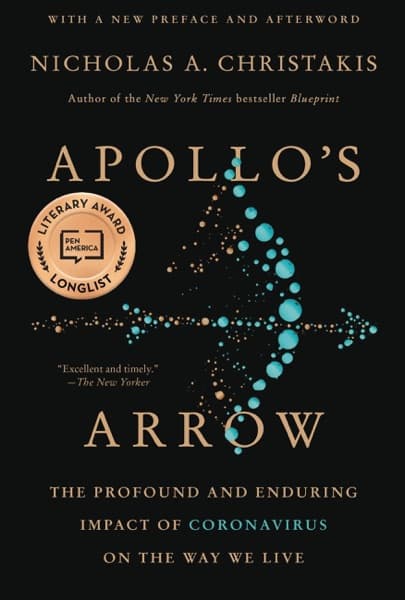
Apollo's Arrow
Nicholas A. Christakis
Apollo's Arrow makes emergence feel unavoidable once you see how population, ecology, and chance converge to create spillover opportunities.
Emergence is a system, not a single event.
This synthesis treats the origins question as part of a larger emergence system, not only a Wuhan puzzle. That matters because it connects COVID-19 origins to the broader logic of how new diseases appear.
The Premonition
Michael Lewis
The Premonition turns “origins” into a story about early warning: the science was there, but the system failed to heed it.
Early warnings can be ignored despite real data.
Lewis follows what U.S. decision-making looked like when early understanding and outbreak signals were incomplete yet actionable. For COVID-19 origins, it adds a crucial constraint: what people could know early often depended on institutions, not just discovery.
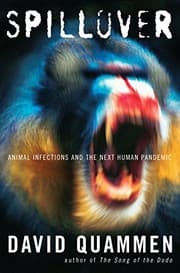
Spillover
David Quammen, Cécile Dutheil de La Rochère, Eva Roques, Laurence Decréau, Pascal Picq
Spillover teaches you to see zoonosis as the default route viruses take when ecosystems and humans intersect.
Many jumps fail; a few succeed and spread.
Even though it is not a COVID-only book, it builds the mechanisms behind animal-to-human jumps that underpin many zoonotic origin arguments. That matters for COVID-19 origins because it gives you a scientific baseline for what “plausible spillover” should look like.
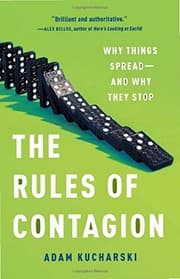
The Rules of Contagion
Adam Kucharski
After The Rules of Contagion, you start asking origin questions through transmission logic instead of vibes.
Small differences can create big outbreak outcomes.
Kucharski translates outbreak dynamics into clear concepts that help you interpret what patterns of spread imply. For COVID-19 origins, that can sharpen how you think about early signals that origin investigations try to explain.
Can we tailor this list for you?
Type your question in the bar below and the AI will tailor a fresh set of picks just for you.